
-
Popular Countries
Country Services
 Vietnam Hub
Country Services
 China
China
Country Services
 Indonesia
Country Services
 Malaysia Hub
Country Services
 Philippines Hub
Country Services
 India
India
Country Services
 Nigeria
Country Services
 Bangladesh
Country Services
 Pakistan
Work Visa & Employment Pass Services Across APAC
Hiring a foreign national is rarely just an immigration question. It is a question of timing, compliance, payroll, and how quickly your new hire can legally start work. Aniday manages the full work visa and employment pass lifecycle for companies expanding into Asia and beyond — so your hires arrive on schedule and your operations stay compliant from day one.
ANIDAY IS TRUSTED BY 5000+ COMPANIES


What Is a Work Visa or Employment Pass?
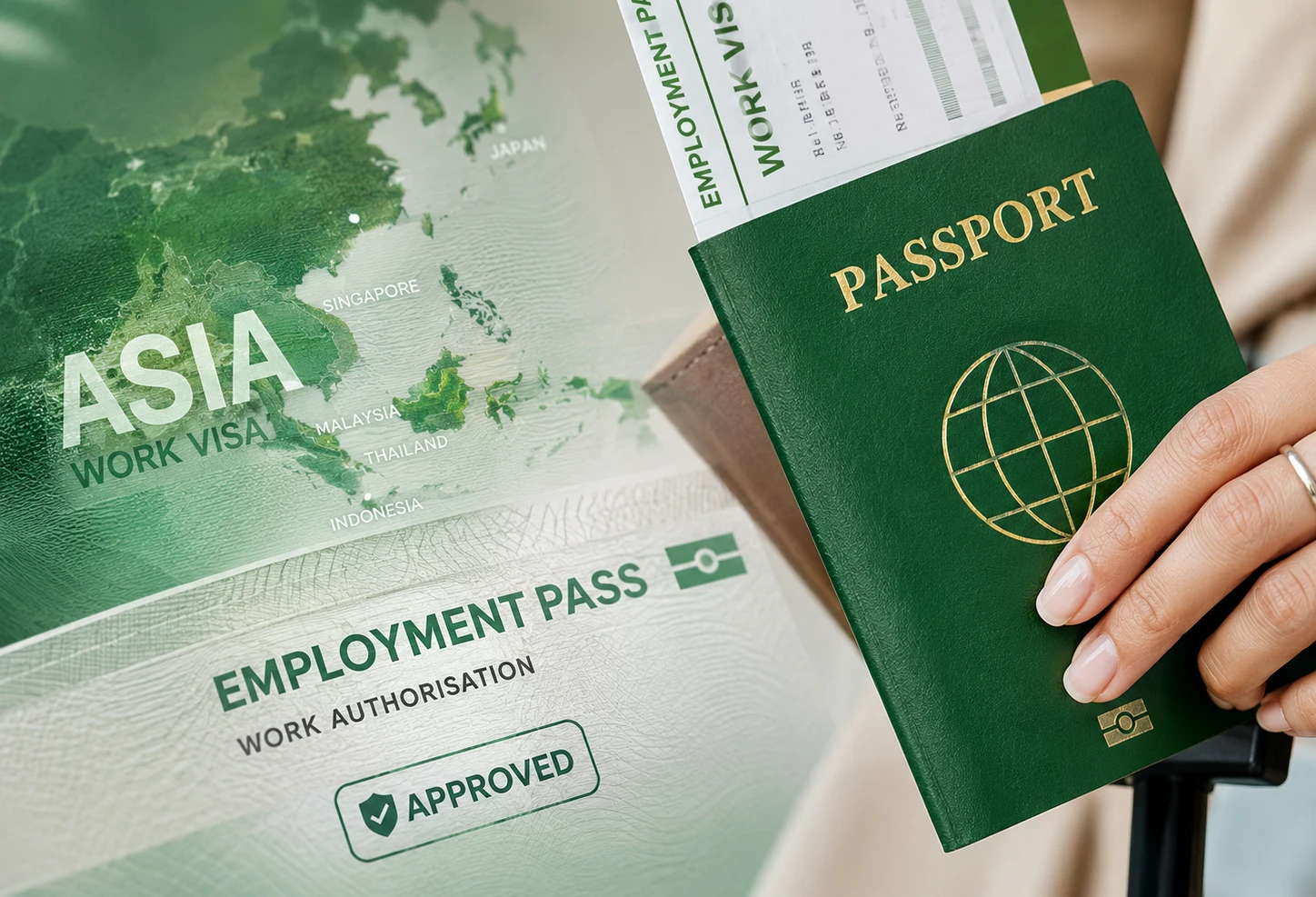
A work visa (sometimes called a work permit, employment pass, or work authorisation) is a government-issued document that allows a foreign national to legally work in a country for a defined period, usually tied to a specific employer and role. An employment pass is a category of work visa typically reserved for professionals, managers, executives, and specialists who meet a minimum salary and qualification threshold. Three things almost every country checks: the employer must be a compliant entity authorised to sponsor; the role must justify hiring a foreigner; and the candidate must meet education, experience, health, and background requirements.
Why Companies Use Aniday for Work Visas and Employment Passes
Aniday combines immigration expertise, EOR infrastructure, and payroll compliance under one roof — trusted by 5,000+ businesses for cross-border hiring.
 Local Expertise & Faster Processing
Our local specialists understand country-specific immigration procedures, helping businesses process work visas and employment passes faster with fewer delays.
 Single Point of Contact
One team for immigration, payroll, and employment contracts — not three vendors that don't talk to each other.
 Eligibility Screening Up Front
We screen role, candidate, and employer eligibility before you commit to a hire — so you never sign an offer you can't sponsor.
 End-to-End Document Handling
Document preparation, notarisation, translation, submission, and government liaison — we handle every step so your HR team doesn't have to.
Types of Work Visas/Passes We Handle
Categories vary by country, but most fall into one of the following groups. Aniday handles all of them across our APAC coverage and beyond.

For managers, executives, engineers, and specialists earning above a defined salary threshold. Examples: Singapore EP, Vietnam Work Permit, Malaysia EP Category I & II, Thailand Non-Immigrant B with Work Permit.

For senior executives, founders, and specialists with significant earnings. Singapore's ONE Pass and PEP sit here, along with similar elite tracks in Japan, and the UAE.

For technical and operational staff who do not meet professional thresholds — such as Singapore's S Pass and equivalent mid-tier categories in other markets.

Allow a pass holder to bring spouse, children, and in some markets parents. Some dependant passes permit work; others require a separate Letter of Consent.

Used for installations, audits, training, and short engagements where a full work pass would be excessive or impractical.

Long-term residence cards and PR pathways that detach the worker from a single sponsor. Aniday supports corporate-sponsored PR where pathways exist.
How Aniday's Work Visa Service Works
-
01
Eligibility & Strategy Call
We map your hire against country options, advise on the right pass category, and confirm whether to sponsor directly or through Aniday's EOR.
-
02
Document Collection
We send a tailored country-specific checklist, follow up with the candidate, and manage notarisations, translations, and apostilles end-to-end.
-
03
Application Preparation & Filing
Our local immigration specialists prepare the application, draft supporting letters, and submit through the official portal or in person.
-
04
Government Liaison
We respond to clarifications, queries, and any requests for additional information — keeping you and the candidate updated at every stage.
Typical Processing Timelines
Realistic ranges based on current government turnaround times and our recent caseload. Add one to two weeks for document collection on the candidate side.
| Country | Common Pass Type | Government Processing | Total Time to Start Work |
|---|---|---|---|
| Singapore | Employment Pass | 10 business days | 3 to 5 weeks |
| Vietnam | Work Permit + TRC | 15 to 20 business days | 4 to 8 weeks |
| Thailand | Non-B + Work Permit | 7 to 15 business days | 4 to 8 weeks |
| Malaysia | Employment Pass | 5 to 7 working days | 4 to 6 weeks |
| Indonesia | KITAS + RPTKA | 10 to 14 working days | 6 to 8 weeks |
| Philippines | 9(g) Pre-arranged Employment | 1 to 2 months | 5 to 8 weeks |
Renewals are usually faster than first applications but should be filed at least 4 to 6 weeks before expiry.
Documents Typically Required
Documents vary by country and pass type, but the core list is consistent. Aniday provides a country-specific checklist at the start of every engagement and handles all notarisation, translation, and legalisation steps on your behalf.
From the Employee
- Passport (valid 6-12 months beyond pass duration)
- CV / resume
- Education certificates with notarisation or apostille. Professional licences where applicable
- Recent passport-style photographs
- Criminal background certificate
- Medical examination results
- Marriage certificate & children's birth certificates (for dependants)
From the Employer
- Business registration certificate
- Tax registration certificate
- Latest audited financials or bank statements
- Signed employment contract
- Job description & organisational chart
- Proof of advertising the role locally (if labour market testing applies)
- Letter of appointment / sponsorship
Work Visa & Employment Pass Services by Country
Local immigration specialists in every major APAC market — with deep knowledge of country-specific pass categories, salary thresholds.
Client Reviews
Real success stories from companies who relocated talent across borders with Aniday.
Work Visa & Employment Pass FAQs
How long does a work visa take to process?
Most professional employment passes in Asia take three to ten weeks from kickoff to start date, including document collection. Singapore is typically the fastest at 3–5 weeks. Indonesia and the Philippines are usually the slowest.
Can I start working before my work visa is approved?
No. Beginning paid work before approval is illegal in every country we operate in and can result in deportation, future visa bans, and employer penalties. Some countries permit limited preparatory activity on a business visa — we will advise on a case-by-case basis.
What is the difference between a work permit and an employment pass?
Terminology varies by country. In most cases, "work permit" is a broader category covering all foreign workers, while "employment pass" refers specifically to professional and managerial roles with a salary threshold. Singapore's EP, Malaysia's EP, and Hong Kong's GEP all fit the latter.
Can my spouse and children come with me?
Yes, in most jurisdictions, holders of qualifying employment passes can sponsor dependants. Whether dependants can work usually requires a separate authorisation such as a Letter of Consent. Aniday handles dependant passes as part of the main engagement.
What Are the Common Reasons for Work Visa Application Rejections?
In our experience, the most frequent rejection causes are recoverable when caught before submission. A pre-submission review by an immigration specialist catches almost all of these.
- Salary below the current threshold (thresholds change, sometimes mid-year)
- Job title or duties that do not match the pass category
- Candidate qualifications that cannot be verified or apostilled
- Employer entity that is too new, too small, or has unresolved compliance flags
- Annual quota exhaustion in the target market
- Insufficient evidence that the role could not be filled locally
- Past immigration violations by the candidate
- Inconsistencies between application form, contract, and supporting documents
What happens if the application is rejected?
We review the rejection grounds, address the gaps, and file an appeal or fresh application. In our experience, most first-time rejections are recoverable when the underlying issue is documentation or salary positioning rather than substantive ineligibility. One appeal round is included in every quote.
Does the employee need to be in the country to apply?
Usually no. Most applications are filed while the candidate is still in their home country. Final collection of the pass and biometric registration is done in-country after arrival.
What happens when employment ends?
The employer is required to cancel the pass within a short statutory window (often 7–14 days). The employee then has a defined grace period to leave the country or transfer to a new sponsor. Aniday handles cancellation as part of the offboarding service.
Can Aniday help with permanent residency?
Yes. We provide PR application support in markets where corporate-sponsored PR pathways exist, including Singapore and several other APAC markets.

Talk to an Immigration Specialist
Send us the role, the country, and the candidate's nationality. We will tell you the right pass category, the realistic timeline, and the total cost within two business days.

Explore related resources