









Recruit and Retain Tech Talents in the AI World
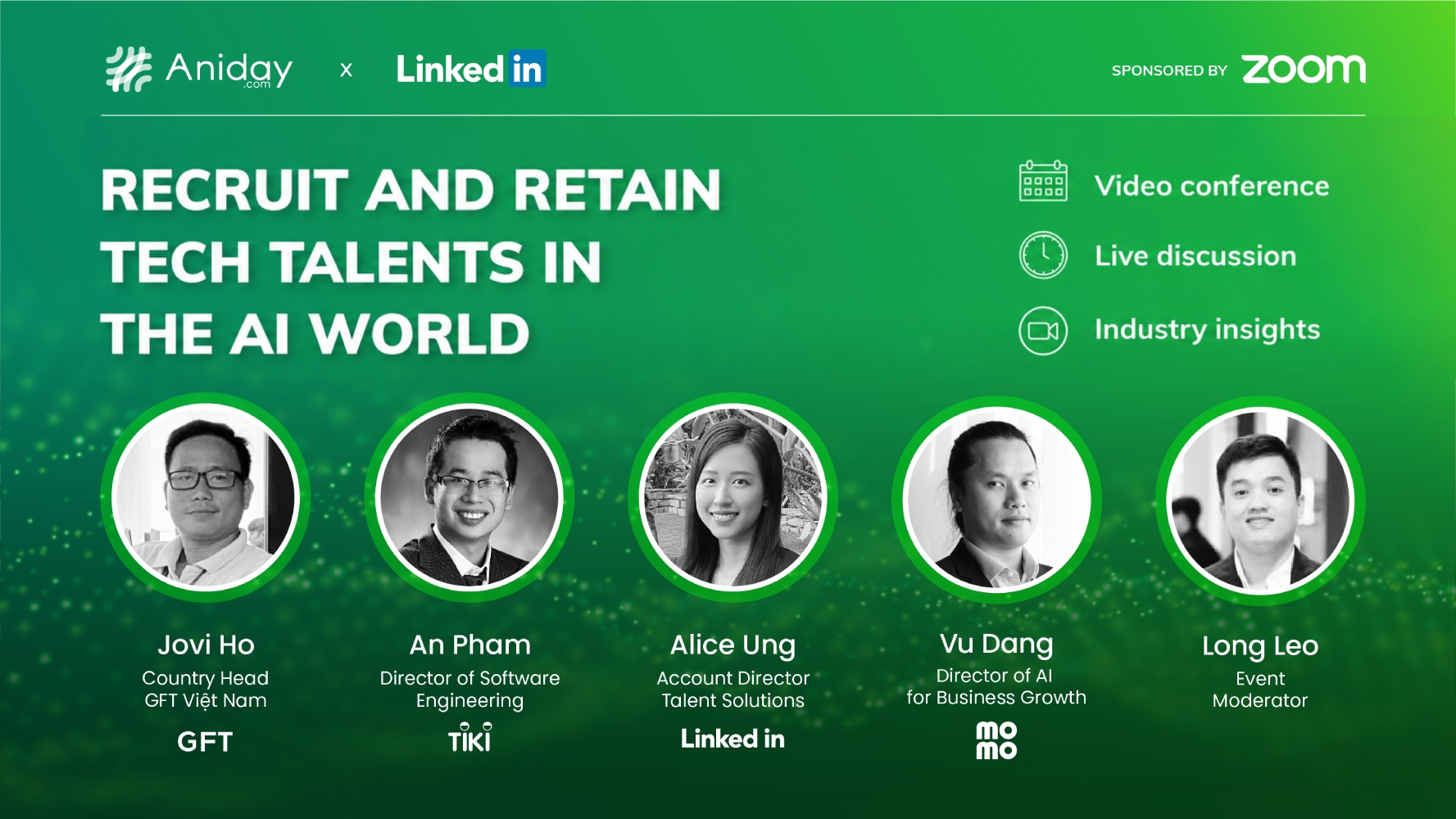
A cross-industry panel on how AI tooling is changing what engineering leaders test for, which roles are getting easier or harder to fill in Vietnam. The session brought together engineering and talent leaders from GFT, Tiki, MoMo, and LinkedIn's APAC Talent Solutions team.

What the discussion covered
The session was framed around a question hiring leaders in Vietnam have been asking out loud since late 2024: do AI tools change who you hire, or only how the people you already have work? The four employer panelists landed on a more specific answer than the framing suggested. Below are the threads that ran across the conversation, with the specific positions speakers took.
1. Senior engineers are not commoditized by AI tooling. The bar moved up, not down.
The common claim that Copilot, Cursor, and GPT-class assistants lower the value of senior engineers did not hold up against what panelists reported on their own teams. Junior output got faster but not more correct. The parts that started mattering more were code review across unfamiliar systems, judgment about what not to build, and the ability to debug AI-generated code that compiles but does the wrong thing under load.
Two of the employer panelists said their junior hiring volume dropped through 2025, while senior demand stayed flat or grew. The candidate funnel for senior roles also got noisier - more applicants who pass coding screens but fail on system-design questions where there is no single right answer.
2. Vietnam's tech market is bifurcating, not uniformly heating up.
LinkedIn's APAC data showed AI and ML role postings in Vietnam more than doubled in 2025, while general full-stack postings flattened. That gap matters because the press coverage tends to treat "Vietnam tech hiring" as one market. It is not. Companies hiring for AI/ML roles are competing on different signals - publications, applied research experience, model deployment history - than companies hiring full-stack web engineers.
Tiki and MoMo both described reorganizing teams around AI use cases before they grew headcount. Search relevance, fraud detection, recommendation pipelines, and growth experimentation moved from project work to standing teams. New hires came in to fill the new structure rather than to expand the old one.
3. Retention now competes on scope and tooling, not just salary.
Three of the four employer panelists said the biggest retention shift in the past year was non-monetary. Engineers asked harder questions about scope (am I going to ship something users see?), manager quality (does my lead actually code?), and AI tooling access (paid Copilot or Cursor licenses, GPU credits for side experiments, internal model access).
Salary inflation slowed in 2025 after two years of double-digit growth. The companies that kept attrition low replaced one-time retention bonuses with mobility programs - structured rotations into AI/ML teams, dedicated "AI hours" during the working week, paid conference attendance. Engineers leaving for higher offers cited tooling and growth more often than base pay alone.
4. "AI proficiency" and "AI engineering" are not the same hire.
The panel pushed back against job descriptions that conflate three different roles:
- General engineers who use AI tools productively. Most of what Vietnamese companies actually need in 2024-2026. The interview signal is workflow, not algorithms.
- ML engineers who deploy and maintain models. A smaller hiring need, but the one that most expands a company's product capability. Different interview loop, different compensation band.
- AI research and applied scientists. A tiny segment that almost no Vietnamese employer outside of MoMo, VinAI, and a few global captives needs to hire at scale.
Several panelists pointed out that JDs blending the three create the worst kind of hiring funnel: candidates from all three layers self-select in, then fail in interviews because the bar is unclear. Splitting roles cleanly cuts time-to-hire materially.
5. Cross-border hiring into Vietnam is no longer mainly about cost.
GFT's perspective on this was direct: German and US clients hiring Vietnamese engineers in 2026 are not primarily doing it for cost savings. The cost gap to Eastern European or Latin American equivalents has narrowed. What they hire for now is time-zone coverage on AI training jobs and incident response, plus specialist skills (CUDA, MLOps, model evaluation) where Vietnam has built up genuine depth.
That changes who employers should be recruiting. Staff augmentation pitches lose to specialist pitches. Cross-border hiring through EOR providers (which removes the local-entity overhead) is one of the channels carrying this shift, because it lets foreign employers run Vietnamese engineers as full team members rather than vendors.
6. LinkedIn signal data reveals retention risk earlier than exit interviews.
Alice Ung's portion of the discussion covered retention indicators visible in LinkedIn's data - profile update velocity, recruiter response rates, post-funding or post-layoff cohort movement - and how Vietnamese employers can read those signals. The takeaway was practical: by the time an engineer accepts a recruiter coffee, the decision has often been made internally for weeks. The earlier signals (profile photo update, "open to work" toggle changes, new endorsement requests) are weaker but actionable.
The discussion noted that this is one place where the partnership between Aniday and LinkedIn matters operationally - Aniday's recruiter network can act on these signals through outreach before competing employers see them.
Speakers
Jovi Ho
Country Head, GFT Vietnam
GFT is a German-headquartered IT services firm with engineering centers across Europe, the Americas, and Asia. Its largest practice areas are financial services and capital markets technology. Jovi leads the Vietnam delivery operation, which serves European and US clients on production engineering and AI delivery work.
An Pham
Director of Software Engineering, Tiki
Tiki is one of Vietnam's largest e-commerce platforms, serving tens of millions of buyers and sellers. An leads software engineering across the marketplace, search, fulfillment, and the AI/ML systems that sit behind product discovery and fraud prevention.
Alice Ung
Account Director, Talent Solutions, LinkedIn
LinkedIn Talent Solutions is the enterprise hiring product used by recruiters at most Fortune 500 companies and a deep base of regional employers across APAC. Alice manages strategic accounts in the region and has visibility into anonymized hiring trend data across industries and geographies.
Vu Dang
Director of AI for Business Growth, MoMo
MoMo is Vietnam's leading e-wallet, serving tens of millions of users and operating one of the country's largest production ML deployments. Vu leads AI applications for growth, fraud, and customer lifetime value, including the team responsible for translating model improvements into measurable business outcomes.
About the Aniday and LinkedIn partnership
Aniday is an official LinkedIn Alliance Partner, one of LinkedIn's certified partners for talent solutions in Southeast Asia. The alliance program is reserved for partners that meet LinkedIn's operational and reporting standards on candidate sourcing and recruiter activity. In practice this gives Aniday access to integrated tooling and joint go-to-market with LinkedIn's regional team.
The partnership runs an ongoing series of practitioner-level discussions in Vietnam and the wider region. The sessions are not vendor pitches. They are designed for engineering and people leaders who want a more honest read on hiring and retention than the average industry report provides. Past sessions have covered tech salary inflation, engineering manager hiring, and the shift from staff augmentation to specialist outsourcing.
About the Zoom sponsorship
Zoom Video Communications sponsored the video conferencing infrastructure for this session as part of its enterprise events program. The platform is used for the live discussion and post-event recording delivery.
About Aniday
Aniday is a Singapore-headquartered HR technology platform. It operates a recruiter network of more than 50,000 specialists across over 50 countries and provides Employer of Record, payroll, company incorporation, and work visa services for foreign companies hiring in Asia. Aniday is funded by Insignia Ventures Partners and CyberAgent Capital and works with 5,000+ businesses, including LG, Heineken, Sea, Gameloft, LINE, and Panasonic.
For Vietnamese employers and foreign companies hiring in Vietnam, Aniday's combination of LinkedIn alliance access and a specialist headhunter network is the operational backbone behind the kind of hiring data and signal work discussed in the session.